
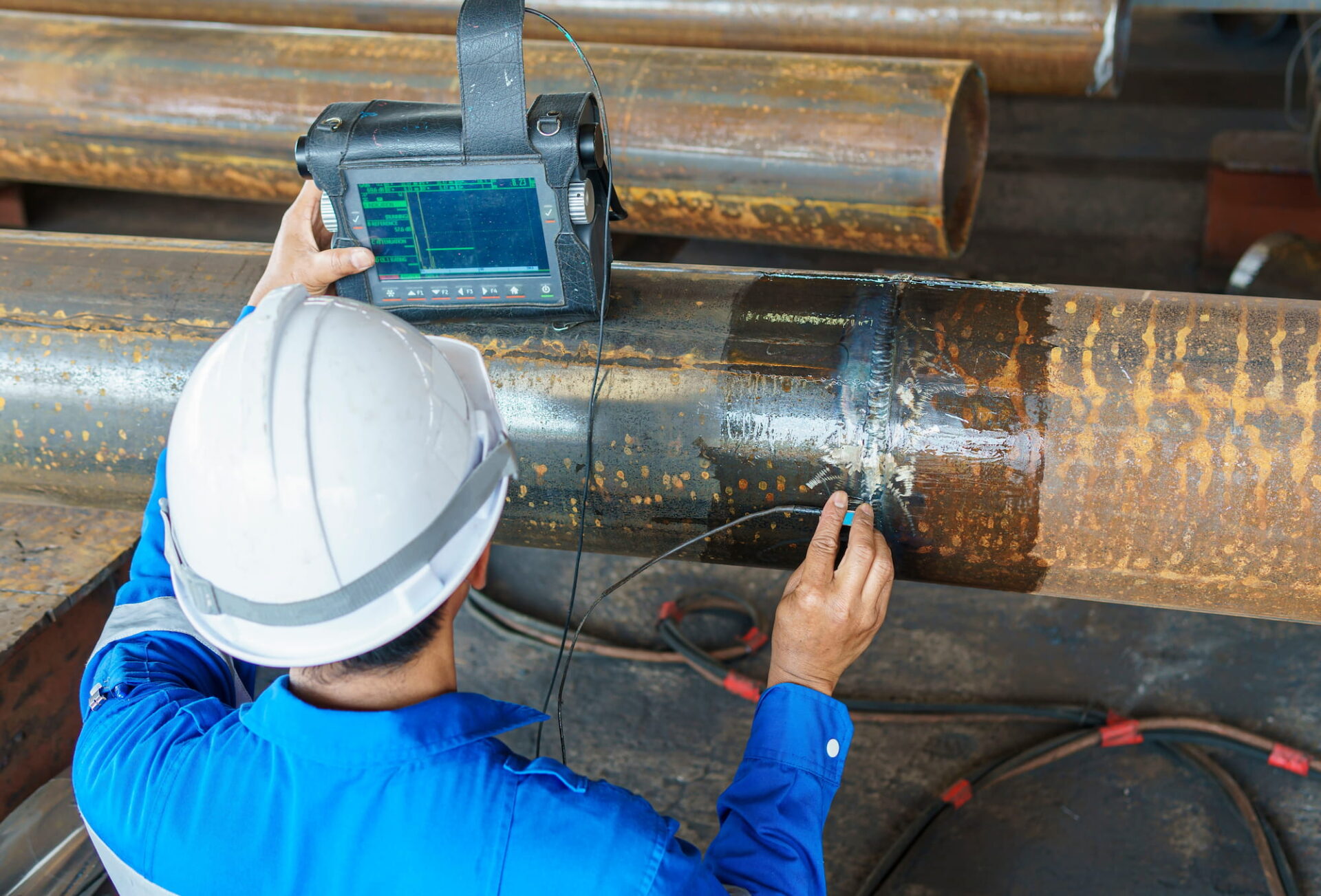
What To Know for Pipe Quality Testing
Many industries rely on the soundness of their pipe and tube systems to transport gaseous and liquid materials. A pipe or tube system suffering from cracks or defects is liable to experience loss of products and could pose a significant health and safety hazard depending on the toxicity of the material as well as any physical considerations (i.e., heat and pressure). One of the primary benefits of pipe and tube testing is that it is possible to conduct nondestructively, which is both cost-efficient and minimizes disturbances to an installed system.
Manufacturers may have multiple questions regarding the content of the material testing process, including (but not limited to):
- What do I need to know before testing? – Individual material tests are often limited in scope to ensure validity for the testing parameter. On the whole, material testing is broad and requires manufacturers to understand which tests are necessary, such as chemical analysis, mechanical testing, and metallography. Material testing also encompasses several scientific domains (chemistry, physics, etc.), and some testing labs cannot cover the service needs for every test.
- Is the size of the material for testing a problem? – The suitability of the testing lab is key: only some labs have access to cranes, forklifts, and other heavy machinery to transport materials and execute procedures. More generally, the size of materials can restrict the applicability of specific tests, like NDT methods.
- How important is accreditation? – Very. Organizations like NADCAP and A2LA ensure that test facilities adhere to industry standards, measurement calibration, and general quality control. The technician performing these tests must also be appropriately educated and trained for best practices. A laboratory may have top-of-the-line equipment, but this matters little to untrained personnel.
- How can a testing lab indicate quality? – While it’s impossible to know the testing quality until receiving the results, labs invested in their processes will post (on-site or online) some level of documentation indicating necessary training, equipment, detailing of the procedure, tolerance, and accept/reject criteria. This shows a commitment to process quality with repeatable results.
- What other services are necessary? – Some work on the pipes or tubes, such as deburring, etching, cutting, and trimming, can extend the testing process. A testing lab offering complete evaluation services and machining can improve logistics by providing a one-stop solution.
Indeed, the cost is a significant consideration and driver of testing lab selection. Still, it’s valuable for those requesting material testing lab services to understand that labs that can perform multiple testing services at a single facility will be more time- and cost-efficient.
Download PDF here
Other Related Articles
End-to-End Additive Manufacturing Testing, All Under One Roof
End-to-end additive manufacturing testing at Laboratory Testing (LTI), supporting AM programs from powder characterization to fully printed parts and builds.…
How Machine Shops Can Make Their Calibration Program Audit-Ready
Machine shops are seeing more audit findings tied directly to their calibration providers. The standards have not changed, but enforcement…
3 Ways to Keep Your Materials Testing Project Moving Efficiently
At LTI, we deliver best-in-class turnaround times, completing over 4,000 orders last year with an average of 3.39 days compared…
LTI Leads the Way with EB/NNS Level 3 Certification
As the Naval Shipbuilders Program moves toward full implementation in 2025, Laboratory Testing (LTI) stands out as a leader in…
Introduction to the ASTM E606 Standard
Low-Cycle Fatigue Testing and the Standards Set Forth by ASTM In the world of engineering, materials are often subjected to…
The Top 5 Consequences of Industrial Operations Not Calibrating Their Equipment
In the fast-paced world of industrial operations, precision is not just a goal—it’s a necessity. Calibration of equipment, a process…