
Article on Fatigue Crack Growth Demonstrates Expertise
A new article by Laboratory Testing’s Guy Connelly is featured in the June 2014 issue of Quality Magazine. The article entitled “Fatigue Crack Growth Testing 101” explains why, how and when the test is conducted and provides an overview of the test methodology without overwhelming detail.
Following an introduction, the article is divided into three sections:
- Fatigue Crack Growth Specimen
- Test Apparatus
- Method and Results
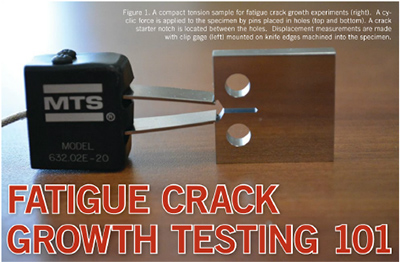 The section subtitled Fatigue Crack Growth Specimen, deals with preparing a representative sample of material with a notch. The next section, Test Apparatus & Method, outlines the testing process to determine crack growth rate and crack growth measurement. The Results section profiles the data obtained from the testing that is used to formulate results. The article also includes images complementing the text and giving readers a visual introduction to samples, equipment and results.
Quality Magazine is a monthly publication that is geared towards manufacturing professionals. Their issues can be found in-print and online.
Material Testing Experts with Diverse Capabilities
 Guy Connelly is a Senior Engineer at Laboratory Testing In his position, Guy works closely with customers that have unique applications to develop special processes, and also conducts routine fracture toughness and fatigue testing. He graduated from Lehigh University with a B.S in Mechanical Engineering and an M.S in Applied Mechanics.
Laboratory Testing performs the fatigue crack growth test to ASTM E647 with the following capabilities:
- Test Methods – Compliance (FCGR-C)
- Control Methods – Constant Load, increasing, decreasing, and constant delta K, and constant Kmax
- Load – load cells capable of running from 50 lbs. to 55,000 lbs.
- Temperature – between -250° F and +400° F
- Test Specimens – C(T) compact tension; M(T) middle tension
- Fixturing – C(T) and M(T) specimen geometries in a range of sizes
In addition to Fatigue Testing & Fracture Toughness Testing, LTI is capable of a wide variety of Mechanical Testing services, including Hardness, Impact, Stress Rupture, Tensile and Elevated Temperature Tensile.
Want to learn more about fatigue crack growth? Contact Laboratory Testing and talk to a specialist today.
Other Related Articles
End-to-End Additive Manufacturing Testing, All Under One Roof
End-to-end additive manufacturing testing at Laboratory Testing (LTI), supporting AM programs from powder characterization to fully printed parts and builds.…
How Machine Shops Can Make Their Calibration Program Audit-Ready
Machine shops are seeing more audit findings tied directly to their calibration providers. The standards have not changed, but enforcement…
3 Ways to Keep Your Materials Testing Project Moving Efficiently
At LTI, we deliver best-in-class turnaround times, completing over 4,000 orders last year with an average of 3.39 days compared…
LTI Leads the Way with EB/NNS Level 3 Certification
As the Naval Shipbuilders Program moves toward full implementation in 2025, Laboratory Testing (LTI) stands out as a leader in…
Introduction to the ASTM E606 Standard
Low-Cycle Fatigue Testing and the Standards Set Forth by ASTM In the world of engineering, materials are often subjected to…
The Top 5 Consequences of Industrial Operations Not Calibrating Their Equipment
In the fast-paced world of industrial operations, precision is not just a goal—it’s a necessity. Calibration of equipment, a process…