
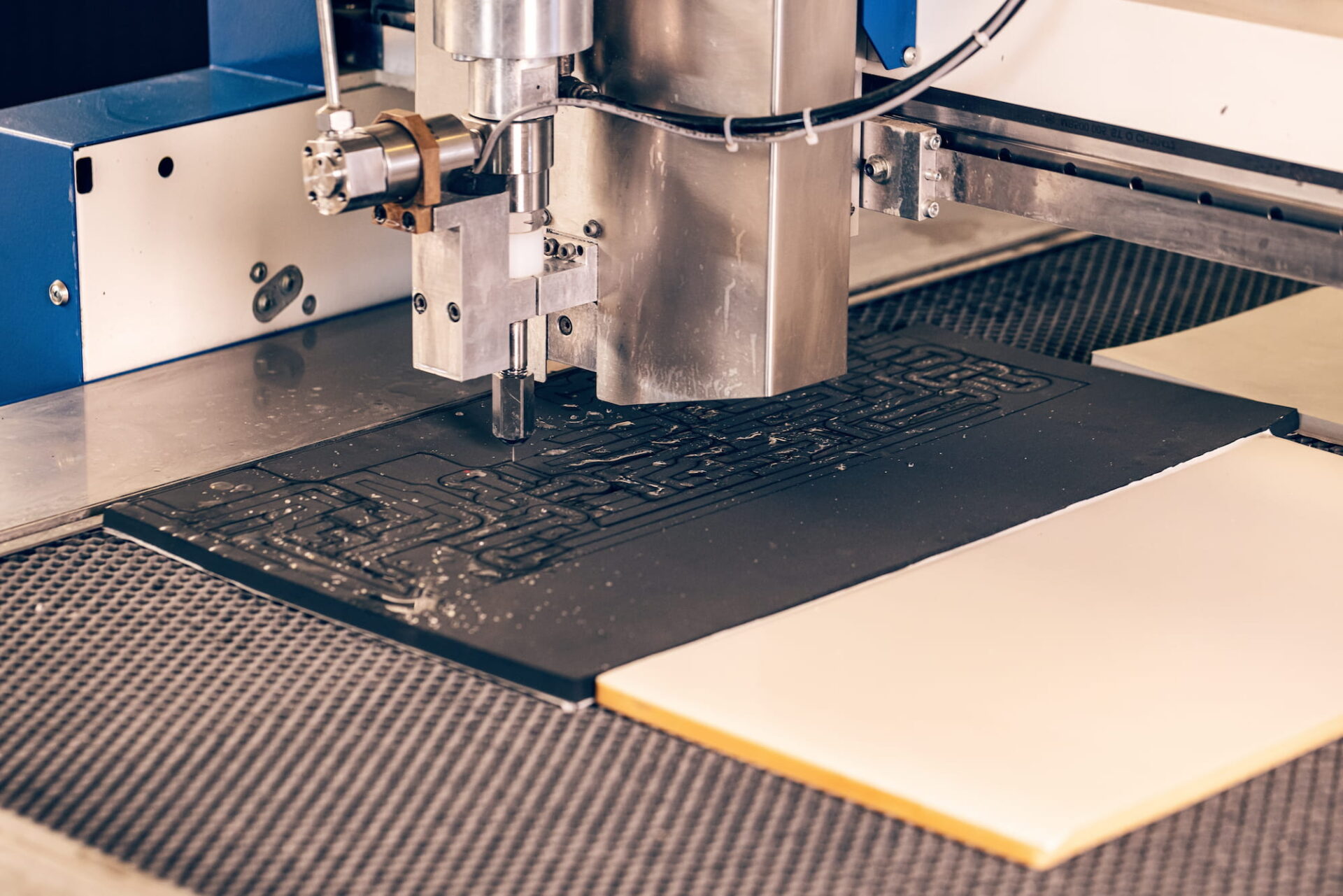
Fast Turnaround and Accuracy are Key
Test specimens are prepared by LTI’s in-house Machine Shop for all mechanical testing performed at our Lab. The Machine Shop runs two work shifts to keep up with the volume of orders needed for testing or sold directly to customers for use in their own labs. Fast turnaround and accuracy are specimen requirements. A well-run, efficient Machine Shop equipped with the latest computer-controlled cutting and machining centers for speed and accuracy is how we get it done.
Maxiem Waterjet Enhances Efficiency
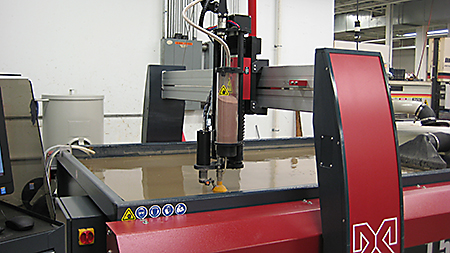
The most recent piece of equipment purchased for the Machine Shop is a Maxiem Model 1515 abrasive waterjet system with a cutting area that fits material stock up to 4 ft. by 4 ft. It provides faster, more efficient cutting of test specimens than more traditional methods, and in addition,
- With the cold cutting process, cleaner parts are produced without heat-affected zones.
- Samples can be cut closer to finished size than with rough-cut saws, thereby requiring less machining time.
- The waterjet can be set up for automated cutting to run unattended.
- Holds a tight tolerance of around .005” (depending on material thickness).
- Work pieces can be cut from virtually any material at significantly faster speeds than traditional machines.
Count On the Precision Specimens You Need
Machining at LTI will produce the precision specimens you count on to get reliable test results. Specimen machining is Nadcap accredited by the Performance Review Institute and performed to ASTM A370, ASTM E8 and ASTM E23.
We have the expertise, staff and equipment to quickly prepare a wide-range of test specimens such as the following:
| Jominy | Stress Rupture |
| Flat & Round Tensile | Flat Fatigue |
| Izod Impact | Rotating Beam & Low Cycle Fatigue |
| Charpy V-Notch Impact | Fracture Toughness |
| Dynamic Tear | Round Compression |
| Compact Tension | Hydrogen Embrittlement |
| Stress Corrosion | Face, Root, & Side Bend |
| Gleeble | Frequency Severity (Steel Cleanliness) |
Ask us about our complete specimen machining capabilities for your metal and polymer testing needs.
Destructive testing depends on sample machining to create a representative sample for testing. While testing receives the focus, it’s the results here that count for approvals. An improperly machined sample can unintentionally falsify test results by affecting the underlying material properties. For example, traditional friction sawing methods produce localized heat at the cut, resulting in heat-affected zones.
In general, heat ages materials, causing embrittlement that undermines the integrity of the sample. While it’s not a guarantee that friction sawing heats samples to the point where the material properties degrade, it is a possibility, and accounting for this change is tricky.
A better solution is a waterjet to abrasively cut samples, as the jetstream prevents localized heating and ensures the integrity of the material transitions to the sample. Waterjet cutting has additional advantages over traditional sawing:
- Machining a sample takes a fraction of the time.
- A larger cutting area due to the overhead configuration supports more machining possibilities while improving safety.
- Decrease in cost and generated waste compared to sawblades.
Waterjet cutting offers greater benefits to the customer, as it is far more conducive to same-day service for rapid approvals.
Download PDF here
Other Related Articles
End-to-End Additive Manufacturing Testing, All Under One Roof
End-to-end additive manufacturing testing at Laboratory Testing (LTI), supporting AM programs from powder characterization to fully printed parts and builds.…
How Machine Shops Can Make Their Calibration Program Audit-Ready
Machine shops are seeing more audit findings tied directly to their calibration providers. The standards have not changed, but enforcement…
3 Ways to Keep Your Materials Testing Project Moving Efficiently
At LTI, we deliver best-in-class turnaround times, completing over 4,000 orders last year with an average of 3.39 days compared…
LTI Leads the Way with EB/NNS Level 3 Certification
As the Naval Shipbuilders Program moves toward full implementation in 2025, Laboratory Testing (LTI) stands out as a leader in…
Introduction to the ASTM E606 Standard
Low-Cycle Fatigue Testing and the Standards Set Forth by ASTM In the world of engineering, materials are often subjected to…
The Top 5 Consequences of Industrial Operations Not Calibrating Their Equipment
In the fast-paced world of industrial operations, precision is not just a goal—it’s a necessity. Calibration of equipment, a process…